Why I Quit Black Desert
During the course of a conversation with a friend a few weeks back, I came to a stark realization – when I’m addicted to a video game the rest of my life seems dull.
When I say addicted, I mean the game causes problems in other parts of my life. The second I said this, it become obvious to both of us just how true this is. In this last gaming cycle I was sucked deep into a massive multiplayer online game called Black Desert Online. I played a sorceress. A mean one. I divided my time between your typical monster slaying and “sandbox” skill elements where I fished off a pier, mined stone, chopped wood, hunted animals, and gathered flowers. I sold gathered ingredients or used them to craft jerky, tools, boats, or potions. For me these skill elements added an incredibly addictive element to the game where I was often leaving my computer on overnight so I could work in-game and felt the need to re-check on my progress every few hours. Towards the final weeks I’d been playing for 15 or 20 minutes before work and found myself rushing home to log in. I was probably putting in 4-5 hours per day on average and another 6 on weekend days. I say addiction because playing a game like this has a severely negative impact on other aspects of my life.
Interestingly, I actually have a way to track this addiction. Using data gathered by RescueTime, an application that runs in the background on each of my computers, you and I can watch this addiction unfold for two months. My email records show that I bought the game on April 17, 2006. A friend, after warming me up in person once or twice, sent me an email with a free beta link and a video review titled “Join meeee”. I downloaded the beta that day and you can see my gaming usage jump. On April 22, I sent an email trying to recruit my brother in. On April 23, I finally bought a full version of the game – upgrading to the deluxe version for a mount and a pet!
In April I logged 37 hours and 10 minutes of Black Desert.
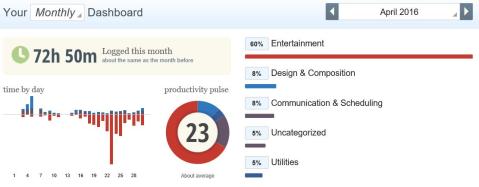
In May I logged 65 hours and 48 minutes of Black Desert. I was on vacation for 3 days from 5/19-5/22 where there’s no activity shown.
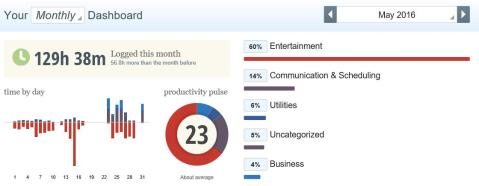
I quit on May 30th. I clicked the “reset password” button, set a new password, and then threw it away.
So, how did I quit? The weekend before, I’d been grouped up with a father/daughter pair. I thought it was neat that they played socially together, but when the father started talking about how he played for many hours every day I had some unpleasant flashbacks to the bad old days. I had also finally reached the “end game” and gotten a brief look into what my life would be like almost every play session if I continued to play. I got a good look at grinding the same mobs, gathering the same stones, and suffering the same old recruiting effort in finding companions to assist me in my quests. I realized during this pivotal conversation that the experience of being in-game for so many hours of my life, no matter how monotonous, dulled the rest of my life.
It’s like a cloudy pallor is cast over life. I can practice guitar for 30 minutes but how many experience points did I gain? I can work for a day and know how much money I made, but where are my gold coins? Where is the leaderboard? I can fish in game so easily without the pain of buying a rod, driving down to the lake, and sitting in the blistering sun. I can chop wood without fear of black widows or losing a toe. I can ride a horse without fear of falling off. I can fight a monster without fear of death. Fear is the resistance we push through in living our lives and in-game I feel no fear.
In June 2016, I logged 0 hours and 0 minutes of Black Desert.
I’ve been MMO clean for 34 days now. Check out my productivity scores for June.
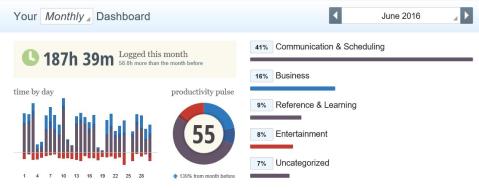 Of the June “entertainment” time, I practiced guitar for 10 solid hours.

In May 2016 this was only 3 hours. Note that the 6 hours of youtube time was all spent watching Black Desert guides! On top of the youtube time, I also found time tracking evidence of many hours spent reading Black Desert forums and tutorial guides.

In April 2016 I also logged only 3 hours of guitar practice. Quitting this MMO seems to have have tripled my guitar practice efforts.

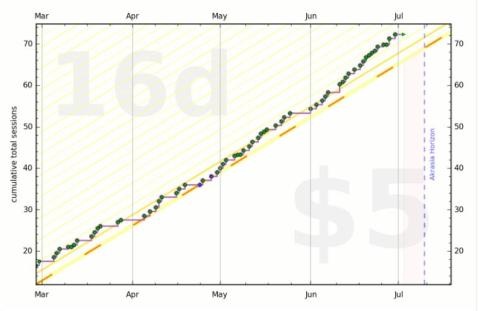
For reference, my personal tracking of my guitar practice goal – which would probably be much more accurate if I did a real comparison against my RescueTime logs to account for unrecorded practice session or fake “weasel” points.
Planning 2015 Goals with Beeminder
I spent 2 days planning goals for 2015 this year. I reviewed three previous years of previously set goals. There were highlights – three years ago my motorcycle was just a dream, my plans to hunt were a vague idea that I should sign up for a hunter’s ed course, and starting my own business was a very long term goal. I’ve achieved all 3 of those goals. This year I set some goals that I had set before and some new ones.
This is serious. I am trying to be as serious about my personal goals as I am about my job.
I tried to apply SMART criteria to my goals. I went to a local meetup to discuss my goals. I put myself through a 40-hour fast followed by a 4-hour isolation tank float during which I visualized myself executing my goals. I practiced setting an “implementation intention” where I tried to imagine exaggerated sensations around my goals – what achieving them might feel, taste, smell, and sound like. I challenged myself by imagining myself a month in the future, having failed a particular goal, and considering what my future excuses would be for failing that goal. When I could think of a good excuse, I made an action item or sub goal specific to resolving that excuse.
This is also the first year that I actually set business goals. By this time next year, I will be as serious about my career goals as I am about each client job I work.
This year I won’t be making the mistake of setting big impossible to achieve goals. I’ve had experience breaking my goals down into smaller chunks. For example, weight loss will not be one of my goals. I do have half dozen habits that I can track though and if I follow them then I am sure weight loss will result.
This year I also won’t be making any “every day I’ll..” goals. Consistency means setting goals that are achievable.
One of the things I’m most excited about is my new tracking app: Beeminder. For each goal I set, Beeminder sends me a reminder email in the morning. I respond to that email with any progress I’ve made on the goal. If I fail to achieve the goal after a certain period of time, Beeminder charges me $5. If I fail again, they up the fee to $10. The fee schedule is: $5, $10, $30, $90, $270, $810, $2430. My intent is to layer in different goals each month that will help me achieve my larger goals.
On January first I set up 3 new beeminder goals:
- Meditate 4 times per week
- Exercise 4 times per week
- Read 4 hours per week
They sound a little underwhelming, don’t they? Here they are again in less than 140 characters:
Daily Goals, per week: Meditate 4x. Exercise 4x. Read 4 hours.
— Justin (@recomphacks) February 16, 2015
The idea here is to take some existing habits and ensure consistency. By setting a goal that I can achieve for the entire year, I am confident that I’ll make these goals happen. In February, I’ll layer in a few more goals.
2015 Goals: Cognitive Enhancement via Keto
Low-carb for me has always been about weight loss, but lately I’ve been thinking about it more in terms of cognitive enhancement. Low-carb started for me as a low-carb, low-fat, and high protein diet called a “protein-sparing modified fast”. For the past decade I’ve often gone through periods of losing a good amount of weight (20 – 40lbs) using that tactic or a more traditional low-carb high-fat. But when it comes to goal setting, weight loss is a lousy goal. First, it doesn’t seem to be achievable for me. Not directly. Second, low-carb itself is not the only tool to get to weight loss.
Enter cognitive enhancement. I almost certainly feel better mentally while eating keto. The mental clarity I get from fasting or eating only fat is unmatched. When I’m supplementing right (enough salt), I do a great job of avoiding brain fog. I make better decisions at work and recover from stressful events more quickly. I feel better overall. Maybe cognitive enhancement is a goal that will help keep me aligned to a low-carb diet?
For 2015 I am setting goals that I think are 100% achievable. Weight loss, in any kind of relative or absolute terms, is not. Daily keto, as a goal, is not. Tracking my food intake daily is achievable. Taking a few minutes each day to be mindful about how I’m feeling and reflect on how what I ate may impact that is also achievable.
Another change I made is 2015 is to do my best to avoid “elimination” goals. What I’ve observed over the past few years is that I’ll often eliminate one habit, which may or not even deserve to have been eliminated, and then quickly get creative about replacing that habit with an equally bad one. Instead, much better to set a desired habit first and then let creativity works its magic in figuring out how to get there.
So this is the tack I’ve taken for 2015: set very small, easily achievable goals that lead to habit formation. How to apply it to my desire to maintain a keto state? First, I need to prevent my gut health from going downhill. So I think one goal has to be to get enough fiber and other plant matter:
“Eat 5 servings of vegetables a day”
Another, I need a way to get excited about cognitive enhancement. I’ve had 3 ideas so far on this front:
“Read 4 hours per week”
“Write 500 words 4 days per week”
“Study online course material 4 hours per week”
My current thinking, after tracking against these reading/writing/studying goals for about a month, is that I cannot achieve these cognitive enhancement goals without the cognitive enhancement that comes from keto. Or, if I can, then I am probably operating at 50% efficiency or lower without keto. I would measure this cognitive performance on two main factors: mental endurance and ability to focus.
One of the most interesting points about these SMART goals that I’ve chosen is that they all feel incredibly underwhelming. There is something to be said for a bombastic, unrealistic goal. However, that is very much not what I am aiming for. I am aiming for consistency in my life. I am trying to form repeatable and sustainable habits and patterns. My belief is that by cultivating this consistency and discipline, I will be able to set and achieve wildly unrealistic goals in the near future.
Gut Update Part 1
It’s time for a long overdue gut update. If you remember from my last post, I went to see a gastroenterologist about some IBS-D problems I’d been experiencing.
Blood Tests
The gastro send me in for blood tests for: CBC, Amylase, C.Diff, metabolic panel, Creatinine, Giardia, H. Pylori (IgG), Hepatitis, Lipase, and Sedimentation Rate. No results found.
Breath Tests
I spent 3 Fridays in the gastro’s office taking Hydrogen/Methane breath tests for lactose intolerance, fructose intolerance, and small intestinal bacterial overgrowth (SIBO). No results found.


I did learn some valuable lessons from this testing though.
Lesson 1: Fasting, Restricted Diet, and White Rice
I was only allowed to eat chicken, baked salmon, and white rice the day before the breath test. This is quite a challenge with my work schedule, so basically I practiced some long fasts with large meals on these days. Rice is also not a normal part of my diet. A pre-testing day might look like:
8:00 am: wake and continue overnight fast
7:00 pm: chicken thighs cooked in chicken broth
9:00 pm: baked salmon and white rice (reheated from frozen)
This protocol alone helped improve my IBS-D symptoms! Why? Perhaps the fast helped reset my GI system? Perhaps the rice added some needed RS to my diet.
Lesson 2: Mindfullness
The second lesson I learned was to hone in on the feeling of my own digestion. After I drank the test mixture for the breath test I started to notice some gurgling and burping. I was of course observing my response closely with a mixture of hope that there would be more of a response. Wouldn’t it be great to KNOW the source of the problem? Even though I didn’t find the source, spending 9 hours this summer noticing this response to food was productive. Coupled with meditation and mindfulness exercises, I am slowly learning to better understand the signals my body is sending me. Taking a few hours off work doesn’t hurt either.
Here are some studies that talk about the effects that meditation and other alternative mind-body interventions can have on IBS-D. CBT and hypnotherapy are both recommended!
Stool Culture
I never even turned in the stool test. After doing the full metametrix panel, I just didn’t feel like it was worth it. Also my symptoms began to improve.
Colonoscopy / Upper GI Endoscopy
I also never went in for the invasive scoping. After seeing my symptoms improve, I decided to hold off. The gastro made it pretty clear that if I was feeling well, then the test might not show anything anyways. I may still go in for these tests in early 2015. I am still weighing the risk/reward.
Conclusions
Based on this battery of testing, it seems like the main problems with my gut are:
- Stress
- Yeast overgrowth (as indicated by Metametrix panel)
- Diet (too low in fiber)
I’ll write some more in my next post about my improving symptoms.
My first date with the stomach doctor
When I started down this path of traditional and evolutionary health, I didn’t have a GI problem. As my general practitioner told me when I casually discussed my symptoms last year: “if there’s no pain, then you don’t have a problem”. So when I write about my potato starch experimentation and stool test results, I generally think of these as optimization hacks rather than a serious medical problem.
About two hours into my first Weston A Price Foundation conference, I realized that I might actually have a chronic GI problem. Frequent cycling between constipation and diarrhea. “Shutting down a bathroom” at least a few times a month. A year and a half later, I finally gathered up the courage to see a stomach doctor. My new $0 deductible ACA healthcare insurance plan surely helped build that courage. The meeting went quite well. The gastroenterologist was a riot. Through a moderate Arabic accent he called me “baby” as if having watched Swingers one too many times. “What can I do for you, baby”. “Let’s do this thing, baby.” “DEATH TO TECHNOLOGY” he shouted as I was leaving, unable to figure out his newfangled computer system.
His line of questioning was very simple: What are your symptoms? How many BMs and what type? Alcohol use? Intravenous drug use?
Based on my answers, he thinks I may have some kind of “functional” communication problem between my gut and my brain. The testing he recommends seems primarily to rule out other acute root causes. He figures that I’m not going to die anytime soon from my symptoms but was supportive of my desire to alleviate them.
“Alternative”
He thinks “there is a lot we don’t know” and likes some “alternative” ideas.
He wasn’t upset that I am on a gluten free diet, but acknowledged that this could skew some of the tests designed to screen for Celiac. He thinks the Genova testing is “very alternative” but does his own version of the same tests. He thinks the idea of yeast overgrowth is “very alternative” but has used anti-fungals in the past on a patient or two.
He wrote out some “alternative” ideas to tide me over until further testing could be done:
- Try Caffeine and Dairy elimination – One week at a time.
- Use a Probiotic – Ultimate Flora or VSL#3
- Ginger or Fennel tea . Cinnamon. Or Circumin? Hard to read his writing.
- Peppermint capsules.
Testing
When he said that his strategy is one of aggressive testing, I was very reassured. This is the approach I would love to take and the main reason that I went to see a stomach doctor in the first place. He’s looking for colitis, celiac, bacterial overgrowth, malabsorption, and inflammation.
He sent me away with many test orders:
- Blood tests for: CBC, Amylase, C.Diff, metabolic panel, Creatinine, Giardia, H. Pylori (IgG), Hepatitis, Lipase, and Sedimentation Rate
- Hydrogen/Methane breath tests for lactose intolerance, fructose intolerance, and small intestinal bacterial overgrowth (SIBO)
- Stool Culture
- Colonoscopy
- Upper GI endoscopy
I haven’t decided yet if I even want to do the scoping. When I pressed him on whether or not the scoping was worth the risk, he said “You take risks every day – you drove here, right?” He is right about that. Not only did I drive, but I was uncharacteristically on my phone almost the entire time checking my email as I rushed between two appointments.
Conclusion
Overall the appointment went pretty well. Having paid quite a bit of money out of pocket to this point for a mix of western and alternative testing, I’m hopeful that insurance will assist with these tests. It will be useful to have a baseline now in case an acute problem is found now or in the future. I set up procedures and appointments a ways into the future as is mandated anyways by his incredibly busy calendar.
Genova 2200 GI Effects Test Results
I received my results today from the Genova 2200 GI Effects Results panel and am sharing some of them here. You can check out a sample report from Genova here: http://www.gdx.net/core/sample-reports/GI-Effects-Compehensive-SR.pdf
This test was taken before starting any potato starch supplementation.
I have much research to do on my own still before even commenting on this. The main target for my functional medicine practitioner side seems to be the yeast issue. While the potato starch has helped, I do not think it has totally stopped the yeast issue.
One interesting side note, the functional med practitioner also identified signs of some periodontal distress.
Proposed action plan:
- Digestive Support (digestive enzymes), L-Glutamine
- Oral Health Items (floss, oil pulling, hydrogen peroxide rinsing)
- Elimination diet: 3 weeks of no sugar/no dairy/no nuts seeds to starve off the yeast. Basically GAPS intro.
- Follow elimination diet up with alternating anti-fungals and biofilm treatments


Resistant Starch Update Day 26: minor setback
I had a minor setback in my Resistant Starch self-experiment. Some intense life stress resurfaced in the afternoon and my GI failed less than an hour later.
I also made two very minor food mistakes:
- forgot to refrigerate my lunch
- ate some “paleo snack” candied pecans w/dried fruit.
I blame the stress for the failure though.
I kept going with my normal maintenance diet including the potato starch/probiotic/yogurt drink. The next morning the GI problems were still there.
Time to go back to a basic gut-healing diet. Bone broth and meat. No veggies and no dairy until I feel better. I think I’ll try to keep up with the RS in water.
Metametrix results coming this afternoon.
Resistant Starch Update: Day 23
- butter and mct in coffee
- 2 ground beef sliders on gluten-free bread, cole slaw, few tater tots
- frozen yogurt with blackberries and a few m&ms-corn tortilla chips (3-4 servings), salsa, cheese
- 1 tbsp honey and a date
- goat kefir, goat yogurt, 4T potato starch blended into 1/2 frozen banana
6 Ways to Prevent Paleo from Extinction
One of my favorite panels at PaleoFX 2014 this year was “Building Not Burning Bridges in the Paleo Movement.”
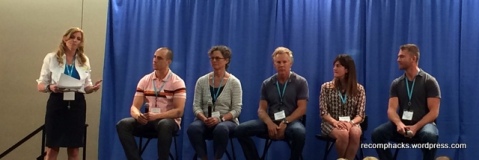
Building Bridges: Michelle Norris, Jonathan Bailor, Dr. Deborah Gordon, Mark Sisson, Diana Rodgers, Robb Wolf
- Support Farmers and Farm to School initiatives.
- Bring newcomers into the fold by going after specific life issues like helping with weight loss or PCOS. Offer a short term cure first to bring them to Paleo.
- Post more local and seasonal recipes. Talk and blog about where you get your food and who your farmers are. Focus on sustainability
- Support the Farm to Consumer Legal Defense Fund.
- Say only things about Paleo that people can’t disagree with. Politicians do this!
- Support Paleo vendors who make Paleo friendly products
https://twitter.com/recomphacks/status/454708878295306241
Potato Starch Day 2: Waiting to Explode
This morning, I mixed a teaspoon of Bob’s Red Mill potato starch into a half cup of full fat goat milk kefir and drank it up. I’m already getting more used to pungent taste of the Kefir. I’m still waiting for the gassy bulletproof explosion or crazy sex dreams that I’ve been warned about. So far neither has happened.
In the afternoon, my new probiotics arrived: Primal Defense Ultra and Prescript-Assist. I haven’t researched these probiotics much. I’m following the leaders at FreeTheAnimal on this one. They really look like soil when you break them open.

I was so excited about the new probiotics and lack of gas that I had to make another kefir drink for dinner. How does “kefir gut bomb” sound?
- 4oz kefir
- soil-based probiotics broken open and sprinkled in
- 1tsp potato starch
- 2oz leftover bulletproof tea (black tea, butter, mct oil)
Mix with immersion blender for frothy goodness.

Food Diary:
Breakfast: 4oz goat milk kefir, 1tsp potato starch, 2oz butter, 1/2oz MCT oil
Lunch: 2oz sprouted almond/mulberry trail mix, 2oz butter, 1/2oz MCT oil
Dinner: 5oz lamb, homemade broth, 4oz goat milk kefir, 1tsp potato starch, 2oz sprouted trail mix
Snacks: 1/3 bar of dark chocolate, 2oz semi-sweet chocolate, bag of seaweed snacks, few tsp honey, some macadamias, more sprouted trail mix
Total calories: 2476 kcal


Ketosis: Based on the ketostix, I was in a strong ketosis in the evening after dinner. In the late evening I snacked on some semi-sweet chocolate chips and was not in ketosis in the morning.
Weight: Down 0.8 lbs from 215 to 214.2 between day 2 and 3. (I’m a 5’8″ male for reference). Today is also weekly measurement day for me. 242 inches total for 8 sites.
GI: Amazing on both day 2 and day 3. Zero gas and great BMs with good volume after a month of IBS-D like GI distress. On day 2/3 at only 2 tsp PS, the credit here goes more to my restricted food choices rather than the potato starch.
FBG: 86mg/dL in the morning of day 3. This is a great number for me. After a night with some sweet chocolate I might see a swing in either direction but not today. Don’t worry I plan to test this with much bigger PS+carb intakes.
 Recomp Hacks